Warning: Illegal offset type in isset or empty in /nas/content/live/ktootest01/wp-content/plugins/advanced-custom-fields-pro/includes/class-acf-data.php on line 96

Warning: Illegal offset type in isset or empty in /nas/content/live/ktootest01/wp-content/plugins/advanced-custom-fields-pro/includes/class-acf-data.php on line 112

Warning: Illegal offset type in isset or empty in /nas/content/live/ktootest01/wp-content/plugins/advanced-custom-fields-pro/includes/class-acf-data.php on line 96

Warning: Illegal offset type in isset or empty in /nas/content/live/ktootest01/wp-content/plugins/advanced-custom-fields-pro/includes/class-acf-data.php on line 112

Business

Juneau Assembly derails affordable housing plan

West Juneau's Island Hills under construction in January 2013. (Photo courtesy Wayne Coogan)
West Juneau’s Island Hills under construction in January 2013. (Photo courtesy Wayne Coogan)

Hyperbole, false assertions and attacks on city staff peppered debate Monday over a plan intended to “unstick” Juneau’s housing market.

In a 5-4 vote, the Juneau Assembly appears to have thrown Step One of that affordable housing plan out the window.

Back in 2014, the Juneau Assembly set aside $75,000 to hire consultants to write up a plan to provide a stable supply of affordable housing. Meetings were held, the market was studied, consultants consulted, and eventually they produced a 68-page housing action plan.

The very first recommendation in that document is to “Formally adopt this plan into Juneau’s comprehensive plan.”

The comprehensive plan is a long-term city planning guide. Say the owner of a property zoned for housing wants an exception to build a bar or a daycare or a pig farm. The city officials who make formal recommendations or decide whether to grant the exception are supposed to refer to the comprehensive plan to see how the request fits into the big picture. It’s one of many considerations they’re supposed to weigh.

Elections shook up the assembly. City staff drafted an ordinance to fold the housing action plan into the comprehensive plan. More meetings were held, public notices were posted, a public hearing was set, and the final step to adopt the affordable housing plan was teed up for assembly approval at its last meeting.

Assembly member Mary Becker made the motion that derailed the plan.

Mary Becker sits in the office of the mayor at Juneau's City Hall on Dec. 3, 2015. (Photo by Lisa Phu/KTOO)
Mary Becker

“I move that we accept the housing action plan by resolution,” Becker said.

That resolution wasn’t on the agenda and had yet to be drafted. Becker clarified, she explicitly wanted to exclude the housing action plan from the city’s comprehensive plan.

Assembly member Debbie White was with Becker. She cited an Oct. 26 memo from a city planner and Juneau’s chief housing officer.

Debbie White
Debbie White

“That basically says if the housing plan is simply adopted by resolution, then it’s a plan that’s aspirational, provides guidance for decision-making. It just becomes a set of guidelines to keep in mind for future actions. If it is adopted and added to the comprehensive plan, it becomes the rule,” White said.

White was echoing the memo closely, but put her own interpretation on that last bit. The memo actually says if the housing action plan is adopted into the comprehensive plan, the main difference is “the review of land use actions for consistency with the comprehensive plan.”

Assembly member Jesse Kiehl tried to straighten things out.

Jesse Kiehl, aide to Sen. Dennis Egan, interacts with a visitor to the senator's office, Feb, 10, 2014. (Photo by Skip Gray/Gavel Alaska)
Jesse Kiehl

“It’s important that we remember the comprehensive plan itself is aspirational, says so,” Kiehl said.

Mary Becker interjected: “It is not and it does not.”

“Well, then I’m happy to pull it up,” Kiehl said.

Kiehl didn’t pull it up for Becker while the mics were hot. But the city codes confirm Kiehl:

“No rights created. The goals and policies set forth in the comprehensive plan are aspirational in nature, and are not intended to commit the City and Borough to a particular action, schedule, or methodology. Neither the comprehensive plan nor the technical appendix adopted under this section nor the amendment of either creates any right in any person to a zone change nor to any permit or other authority to make a particular use of land; neither do they constitute a regulation of land nor a reservation or dedication of privately owned land for public purpose.”

Then, White, a Realtor who owns Southeast Alaska Real Estate, said she opposed the entire housing action plan and said it would make development harder.

“Frankly, a lot of times, our city departments don’t even really appear to be open for business, because they’re looking for ways to deny,” White said.

After that claim, she bristled in an allusion to one of the non-binding housing plan recommendations.

“I don’t know where we get these harebrained ideas to make things as difficult as we possibly can on property developers. But, let the free market do its thing. Don’t force people to build a certain percentage of their project as being subsidized housing. Don’t – I mean, there’s just so many other things we could be doing,” she said.

White’s subsidized housing comment is a misrepresentation of what’s known as inclusionary zoning.

The concept is to give developers an incentive – the right to build more homes on a given property than the zoning otherwise allows – on the condition that the developer sells a percentage of the new homes at an affordable price. It’s been implemented elsewhere as a mandatory or voluntary program.

Assembly member Maria Gladzisewski, a former planning commissioner, rebutted White.

Maria Gladzisewski, July 30, 2015. (Photo by Jeremy Hsieh/KTOO)
Maria Gladzisewski

“The point is to give the planning commission and the planners tools, and more incentive to, in fact, approve these projects, because the comprehensive plan acknowledges that we want to do everything we can, to, as the consultants said, unstick our housing market,” Gladzisewski said. “So it is in fact, designed to do the opposite of making things harder.”

The assembly had a similar debate at the committee level on Halloween. This week’s lasted about 35 minutes before ending in the 5-4 vote.

Assembly members Jesse Kiehl, Maria Gladzisewski, Loren Jones and Norton Gregory voted against the resolution, with the understanding that if it failed, then the next vote would be for more formal comprehensive plan ordinance originally scheduled.

Mayor Ken Koelsch and assembly members Jerry Nankervis, Mary Becker, Debbie White and Beth Weldon voted for the squishier resolution.

The city attorney said she’d draft the resolution for the assembly’s next meeting.

Marijuana sells out at Rainforest Farms’ opening day

rainforest farms opening day line
The line at Rainforest Farms for its opening day of legal marijuana sales stretches down Second Street and around the corner in downtown Juneau, Nov. 25, 2016. (Photo courtesy Mary Uyanik)

Friday was the opening day for marijuana retailer Rainforest Farms, and they had to close early because they sold out.

Facebook users shared photos showing lines to the store running down Second Street and around the block for the first legal marijuana sales in Juneau. The business planned to open at “high noon” and close at 6 p.m., but closed early after running out of product.

On Facebook, the business says it will harvest another crop this week and re-open in a few weeks. Rainforest Farms is the first business in town to make it to retail.

At least 10 other ventures in town have sought state licenses in Juneau for one or more aspects of the marijuana business – separate licenses are required for growing, processing, retailing and testing.

Rural lawmakers wield power without recent precedent

Wood River Bridge ribbon cutting
DOT Commissioner Marc Luiken, Aleknagik Mayor Jane Gottschalk, Sen. Lyman Hoffman and Rep. Bryce Edgmon cut the ribbon on the Aleknagik Wood River Bridge in October 2015. In 2017, Hoffman will be the Senate Finance Committee co-chairman and Edgmon will be House speaker. (Photo by Misty Nielson)

Dillingham Democrat Bryce Edgmon will be the first speaker of the Alaska House of Representatives from off the road system or outside of Southeast Alaska since Nome’s Howard Lyng in the Territorial Legislature of 1941.

And other rural lawmakers will hold more important leadership posts in the next legislature than they have had in decades.

Edgmon and two key committee chairmen are from northern or western Alaska.

Nome Democrat Neal Foster will be co-chairman of the House Finance Committee. Bethel Democrat Lyman Hoffman will be co-chairman of the Senate Finance Committee. It will be the first time both budget-writing committees will have chairs from Bush Alaska since 1990. Hoffman also was a finance chair then, when he served in the house.

Edgmon said the rural leaders are part of a broader regional balance that will be good for the entire state.

“I think it will be good for rural Alaska, and from my standpoint, it’s always good to have regional diversity on the finance committees,” as well as other committees, Edgmon said.

Rural lawmakers have a tradition dating back decades of joining majority caucuses. But this session they’re playing a particularly central role in control of the House. Edgmon and Foster joined with three Republicans to switch from the current Republican-led majority to the primarily Democratic incoming majority.

What this means for rural residents is uncertain. Rural lawmakers have traditionally argued for maintaining or increasing government services. Service increases will be difficult due to the state’s budget crisis. But the incoming House majority is interested in striking a balance that includes both spending cuts and new revenue, like a broad-based income or sales tax, to maintain services. Edgmon expects Foster and his finance committee co-chair Paul Seaton will keep this in mind.

“Both individuals – Rep. Seaton from Homer, Rep. Foster from Nome – are very committed to taking a balanced approach to figuring out the fiscal challenges that lie ahead,” Edgmon said.

Former University of Alaska Southeast political scientist Clive Thomas noted the state government funds a large share of jobs in rural Alaska. And Thomas expects the rural lawmakers to be at the forefront in defending school funding.

“It’s a major income generator in most villages – probably the major income generator – so I think that’s one of the things that they will be concerned about and want to protect,” Thomas said.

Edgmon said there’s another historic element of the new leadership.

“I’m very proud to be the first speaker of Alaska Native heritage,” Edgmon said. “And that’s something that I hope can serve as a role model for future speakers with Alaska Native blood.”

Edgmon said he’s a little less than a quarter Aleut, and he also grew up learning Yupik words and phrases in Dillingham, where the two cultures overlap.

“I grew up in a small town, so I bring small-town values to whatever I do,” Edgmon said. “And I think by nature I’m somebody who listens first and I’m not always the biggest talker in the room. And maybe that hearkens back to my Alaska Native upbringing.”

The budget’s effect on rural areas and the rest of the state will be clearer in mid-December, when Gov. Bill Walker is scheduled to unveil his budget proposal.

Small explosion delays Healy 2 startup

The Healy coal power plant on July 8, 2011.
The Healy coal power plant on July 8, 2011. (Creative Commons photo by Travis)

Golden Valley Electric Association customers will see a slight decrease in their monthly bills next month, but well short of what GVEA had hoped to give ratepayers. That’s because the co-op has run into more problems with Healy 2 power plant.

Golden Valley President and CEO Cory Borgeson said the co-op had hoped by now, Healy 2 would be producing low-cost electricity generated by the cheapest fuel – coal. But he said a small explosion on Nov. 2 forced GVEA to shut down the power plant earlier this month, and that means the average residential customer will see their next monthly bill go down by about 65 cents.

“The fact that we won’t be able to be running this lower-cost coal energy from Healy 2 is going to impact our cost of power,” Borgeson said in an interview this week.

Borgeson said repairing damage caused by the explosion will again delay startup of the coal-fired plant near Healy, this time by up to four months. He says the explosion caused about $1 million in damage to the system that feeds pulverized coal into a combustion chamber. A team of experts brought in by GVEA determined that’s where the blast occurred.

“There was a buildup of this coal dust in an area of the coal-handling system,” Borgeson said. “And, during a process of where we were shutting down the plant, it became oxygen-rich. And a small ‘puff,’ or explosion, inside the coal-handling tubes occurred.”

No one was injured in the explosion. Borgeson did not have an estimate on the cost to repair damage to another part of the power plant that was also damaged by the blast. He expects insurance will pay for most of the damage, which he says was not as extensive as that caused by a much bigger explosion at the plant in March. But he regrets the plant is not yet providing the low-cost electricity that GVEA officials had anticipated.

“Healy unit 2, when it is running and is going, will lower the cost of power for our members,” Borgeson said.

The year’s blasts were the latest in a series of mishaps that have kept Golden Valley from bringing Healy 2 online. GVEA has invested more than $175 million to buy and upgrade the plant since the purchase was finalized in 2013. The 50-megawatt plant was built by state and federal agencies at a cost of more $300 million to demonstrate technology that advocates said would use low-grade coal to generate electricity with less pollution. But it was never able to consistently do that and plagued with problems, so the agencies mothballed it in 2000.

Borgeson said the unusual design of the plant makes it hard for GVEA to solve many of its problems.

“The restart of Healy unit 2 has become a much more difficult, perplexing effort than we had anticipated or hoped for,” Borgeson said.

GVEA management and board of directors talked about Healy 2 on Monday in a closed-to-the-public executive session during the board’s monthly meeting.

Trump’s international business dealings could violate the Constitution

Donald Trump’s extensive business dealings around the globe have focused attention on an obscure provision of the Constitution most law professors barely look at — the Emoluments Clause. Now, one of the hottest legal debates around is whether the president-elect is going to violate the Constitution if he continues doing business with companies controlled by foreign governments.

Who even used the word “emolument” in an actual sentence before November 2016?

Emolument is defined by Merriam-Webster as “the returns arising from office or employment usually in the form of compensation or perquisites.”

The Foreign Emoluments Clause can be found in Article I, Section 9 of the Constitution. It provides that “no Person holding any Office of Profit or Trust under [the United States] shall, without Consent of Congress, accept … any present, Emolument, Office, or Title, of any kind whatever, from any King, Prince, or foreign State.”

The clause has been interpreted as an anti-bribery provision by constitutional scholars.

“The underlying concern of the clause is divided loyalties,” said Erik Jensen, a law professor at Case Western Reserve University. “The founders wanted U.S. officials not to have any arrangements under which there could be questions about whether they were acting in the best interests of the United States, or in the interests of a foreign state.”

Trump’s companies do deal with businesses that are controlled or influenced by foreign government officials. Legal experts say the potential for constitutional violations is high.

Take the Bank of China, for example. It’s a lender for one of Trump’s buildings in Midtown Manhattan. If the Bank of China were to offer Trump a lower interest rate on that loan after he takes office, it might raise an Emoluments Clause issue. Some legal scholars say it could be perceived as an attempt to curry favor with the president or influence policy.

So what is a violation of the Emoluments Clause?

Problem is, what constitutes a violation of the Emoluments Clause is a tangled conversation that very quickly involves lots of hypotheticals — because there is virtually no case law on the subject.

Not only have prior presidents been careful to steer clear of any perceived violations of the clause, there’s never been a president like Trump, whose companies have such vast global reach. And Trump hasn’t fully disclosed the full extent of his global business dealings.

So all legal experts can do now is pose possible scenarios.

Objects Versus Services

Richard Painter, who was chief White House ethics lawyer under President George W. Bush from 2005 to 2007, likes to use this example: Imagine the president sells a car to the Queen of England. If the Queen pays the president fair market value for the car, it’s not a violation of the Emoluments Clause. If the payment the president receives exceeds the fair market value of the car, there could be a violation. The amount of over-payment could be seen as a gift, or “present,” under the clause.

But let’s say we’re not talking about an object, like a car. What if the president renders services for a foreign government and receives compensation for those services? That would fall under the definition of “emolument.” And in that case, Painter says, it doesn’t matter if the compensation amounts to fair market value. It’s straight-up compensation for services rendered, so it’s banned as an emolument under the clause.

Here’s how a President Trump might one day render services for foreign government officials. Say a bunch of diplomats from a foreign country stay at Trump International Hotel in Washington, D.C. Painter says you could interpret that as services rendered by Trump — and under the Emoluments Clause, he can’t enrich himself from those rendered services.

“The services theory would be along the lines of, ‘Well, if Donald Trump himself as president could not perform services for the foreign government, he can’t have his hired help — people who work for him in that hotel — provide those services, and then he receives the payment.’ That would be an end-run around the prohibition on any type of emolument,” said Painter.

The issue of whether a U.S. government official is violating the Emoluments Clause for services rendered actually does comes up in real life, says Ken Gross, a government ethics lawyer in Washington, D.C. Sometimes government officials go on a foreign detail or sabbatical and want to earn compensation for teaching at a government-funded university in that foreign country. In those cases, Gross said, U.S. government officials have had to forego pay to avoid violations of the clause.

The role of Congress

Under the clause, Congress has the power to consent to any business dealings that raise questions. But if even legal experts are scratching their heads about what constitutes a violation of the Emoluments Clause, imagine how lawmakers would feel entering this legal morass.

“What this does is put Congress in an almost impossible situation of judging the fair market value of financial transactions between state-run entities and the Trump Organization,” said Zephyr Teachout, a law professor at Fordham University. She was a Democratic candidate for Congress in New York this year.

And if Congress dodges its duty under this clause — and refrains from ever voting to approve or reject possible Emolument Clause violations — Teachout says Congress will be acting unconstitutionally.

“This is an active obligation on the part of Congress,” said Teachout. “So if Trump goes forward with his plan to maintain a Trump Organization with relationships to state-controlled companies, it’s not just Trump, but it’s Congress that is in violation.”

Who can bring a legal claim against Trump for a violation?

Because there’s been no real litigation of the Emoluments Clause, legal experts say it’s hard to define who has legal standing — meaning who has been injured by the possible violation — to bring a claim.

Legal standing depends on how you articulate the injury. Here’s one theory of injury: Trump is enriching himself at the expense of companies that can’t compete for business the way the president of the United States can. So maybe a company that’s lost business because of some financial transaction between Trump Organization and a foreign government could articulate a legal claim.

Or, the perceived harm could be more nebulous. Here’s another theory: Trump is opening himself up to attempts by foreign governments that want to influence U.S. policy. But who would have standing to bring a legal claim in that case? Legal experts say it’s not clear.

So how does Trump avoid any violations of the Emoluments Clause?

Painter says the best option for Trump is to simply liquidate his stake in his company — that is, take the company public, sell off all his shares and put the cash proceeds in a blind trust. That way, if there are any entanglements between the Trump Organization and foreign countries — he’ll be cleared of any conflicts.

But nobody’s holding their breath for that to happen anytime soon.

Jensen says he can already hear Trump’s counterargument. “He’s going to make at least two points. One, ‘You force somebody like me to do that, and you’re providing a tremendous disincentive for people who have been successful in business to enter the public sphere,’ ” said Jensen. “He also might say, ‘If I have to sell everything very quickly, in effect a fire sale … I will end up getting a lot less than the real value.’ ”

Copyright 2016 NPR. To see more, visit http://www.npr.org/.

Mental Health Trust leadership change official

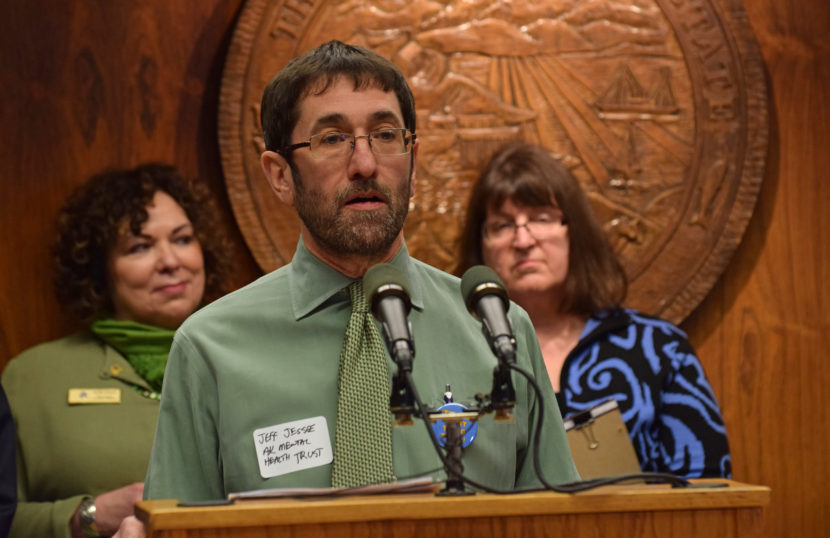
Alaska Mental Health Trust Executive Director Jeff Jessee tells reporters why he supports Gov. Bill Walker’s efforts to expand Medicaid at a press conference in the Capitol, March 17, 2015. Gov. Walker had just announced that he had introduced a bill that he hopes will lead to Medicaid overhaul and expansion. (Photo by Skip Gray/360 North)
Jeff Jessee has officially resigned as CEO of the Alaska Mental Health Trust and will take a new position as a program officer. Photo taken on March 17, 2015. (Photo by Skip Gray/360 North)

The change in leadership at the Alaska Mental Health Trust Authority was made official on Thursday. Many trust advisory boards and beneficiaries expressed concerns about the Board of Trustees’ unexpected October decision to hire retired Trust Land Office Director Greg Jones as the interim CEO.

Former long-time CEO Jeff Jessee officially resigned his position and will take a new post as a program officer.

The governor’s office signed an official memorandum on Tuesday allowing for the change, though Jones may only be hired on an interim basis.

In an email to concerned advisory board members and citizens, Deputy Chief of Staff John F. Hozey III wrote the changes were approved “on the condition that final decisions regarding a permanent CEO require consultation with the supporting boards.”

He also wrote that the governor will consider the concerns when deciding who to appoint to the board in the coming weeks. Trustee Larry Norene’s term expires March 1, 2017. He is eligible for reappointment.

“It is through the appointment process that the Governor can affect the direction of any board,” Hozey wrote. “It is not appropriate for the Governor’s office to micro-manage individual actions that are within the legal responsibility of any board.”

During Thursday’s Trust board meeting, Trustee Jerome Selby asked the board to reconsider the decision.

“I’m gravely concerned, Mr. Chairman, because I think we heard some good input yesterday from a number of folks [during public comment] that maybe we need to step back, slow down a little bit,” he said. “We’re moving too fast. Our house is not in order.”

The seven-member board voted along the same 4-3 split as the original decision to replace Jessee.

Jones, the new CEO, was not present at the meeting because of a previously planned trip.

During an interview, board chair Russ Webb said shifts in leadership are normal and often make people feel anxious and uncertain, but things will quickly smooth over. He said they listened to the community’s comments with interest.

“I think unfortunately there’s much of the issues related to this are not a matter that can be made of public record,” Webb said.

Other board members, during and after the October 26 meeting, said they thought the decision-making process to change the CEO indicated potential violations of the Open Meetings Act.

Webb said those allegations “are neither true nor correct.”

“I won’t further address allegations made by anyone,” he said. “I think it’s frankly beneath me to do so.”

The Board of Trustees has authorized up to $35,000 to be spent on a facilitated training session on the Ethics Act and the Open Meetings Act, and a discussion of the reorganization of the Trust Authority. It will be led by the Trust’s independent counsel, Nelson Page, through a separate contract.